
This page provides updates and further understanding of the various enamleing techniques. Table of Contents
|
||||||||||||
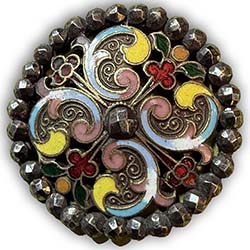
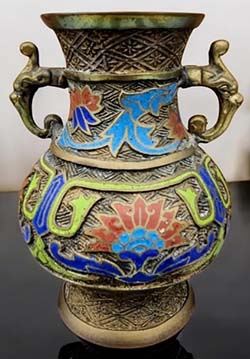
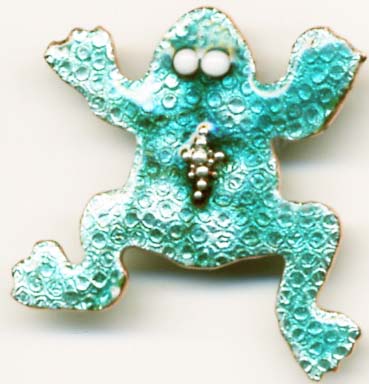
ChamplevÉChamplevÉ Masquerading as CloisonnÉOn pages 46-47 there is a sidebar providing 6 ways to distinguish the differences between these two techniques. Here is another one... This question is whether this button is Cloisonne or Champleve. Although it looks like wires, there is no enamel in the "background" of the button, which would make for the "wires" to not be structurally secure. Anyway, this little beauty is most likely cast and thus forms "depressions" to receive the enamel. Enameling in depressions is the defintion of the technique of Champleve. Thus this button is Champleve.2ndOrder4Brocade_Names_web Consider this vase. It is not totally the same as the button but similar. It is an example of a style of Champleve designed by the Koizumi Company in 20th century Japan. This can be referenced in Schneider's book The Art of Japanese Cloisonné Enamel on page C-31, Fig 121.
|
||||||||||||
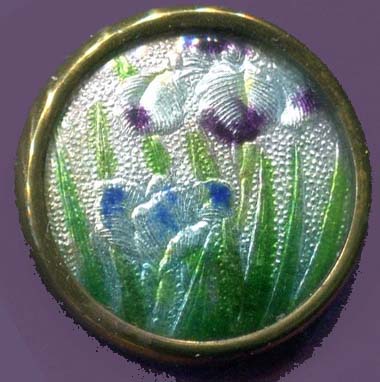
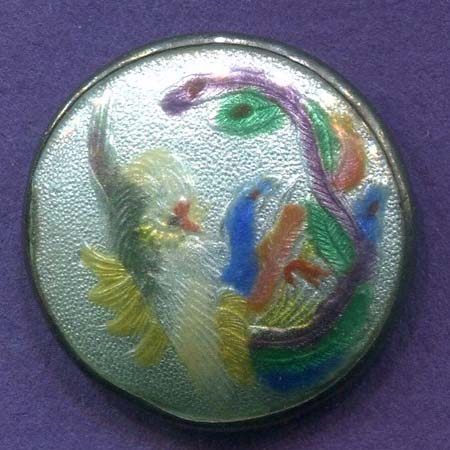
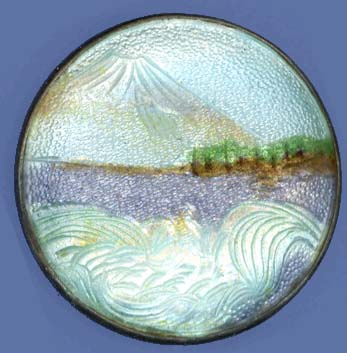
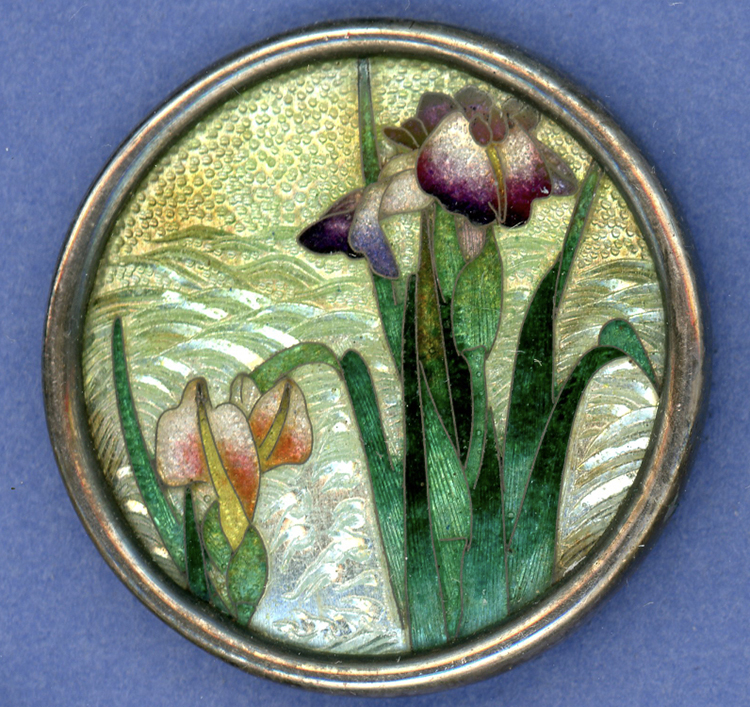
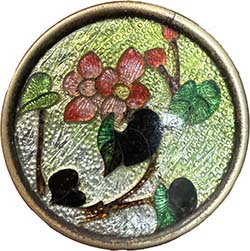
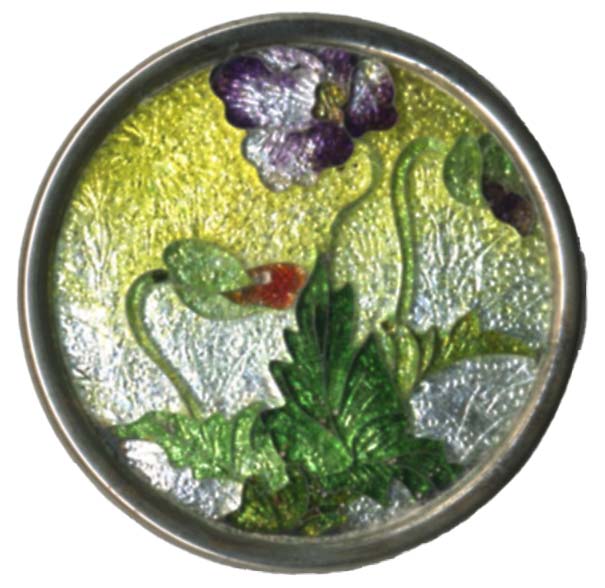
Gin-bariIn general, Gin-bari is an embossed foil technique. That means that the design has to be outdented! Many similar looking Japanese Silver Basse Taille designs have dots that are indented which cannot be made by embossing and is one way to tell the difference. However, sometimes the embossed design will look somewhat indented as in this 5/16" dimi:
The reason it looks like this follows: These dots look like they have outdented rims but most have indented centers. This can happen during the stage when the foil is fused to the enamel layer underneath it. When the embossed foil is fired on, usually you use a tool that I’ll call a “poofer” to pat down the foil so it solidly sticks to the underlying enamel. At that point, the top of the embossing might indent. But you can see the “rim” of it is embossed so that’s the key to look at. Here is one of mine where you can see the same thing and I KNOW this is Gin-bari because I made it. lol
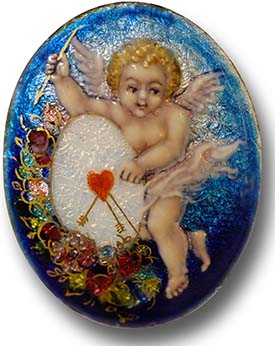
In the past button world, Gin-bari was not well understood. It is a Japanese technique that uses silver foil to completely cover the base of the image. The foil does not have to be textured, but in general, especially in buttons, it frequently is. Here is a button that was on the cover of the Februrary 2011 Bulletin and it's description is not correct which I will discuss below.
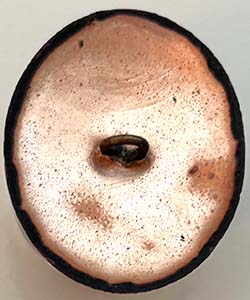
This button (owned by Carole Adrian) has the same look as button #208 pg 56 in my book. I expect they were made by the same artist. This does not look like it was made in Japan, but all techniques were/are done in a variety of countries so you can't say this isn't Gin-bari if it was made in a different country, because it fits the defintion - the base is totally covered with silver foil. Button #208 was not listed as Gin-bari in my book because I didn't think of that at the time, but it is also Gin-bari. In fact, many of Diana Weiler's Cloisonné buttons are also Gin-bari because she typically uses copper and puts down a layer of silver foil before she does her wires. These, too, collectors have not considered Gin-bari, but they are. The Feb 2011 cover says this has multiple colored foils. But that is not true - this only has silver foil for the background and some gold foil under the wings and "skirt" below the cherub's left arm. The "multi-colored foil" is really silver foil with transparent enamel over it. Remember that enamels have to be fired at high temperatures in a kiln and can only take metal foils which come in silver, gold, platinum and copper. Note also that the wings and "skirt" are Grisaille (actually Camaïeu) as they are built up white over the gold foil. The cherub in this one is not Grisaille because the build up for enamel does not take advantage of the background color for it's shadows, like button #208 does. Grisaille requires a build up of layers of white (and sometimes tints) to form the highlights and shadows and thus the background always shows through. The description of this button in Feb 2011 bulletiin also says this is Limoges-style. I do not think it is because the foil does not enhance the painted object itself (it's only the background). Button #208's description also does not say it's Limoges-style. Then again, except for references in my book, Limoges-style is not defined in the button world. Because of the foil, I would give this a BOD for being Limoges-style. Note the counter enamel: do you recognize this as being done with clear enamel (called flux)? See Figure 2.5 page 34 in my book. |
||||||||||||
Gin-bari vs Japanese Silver Basse TailleThe 2027 Blue Book section 4-1.6, is for Gin-bari/gin-jippo. This states:
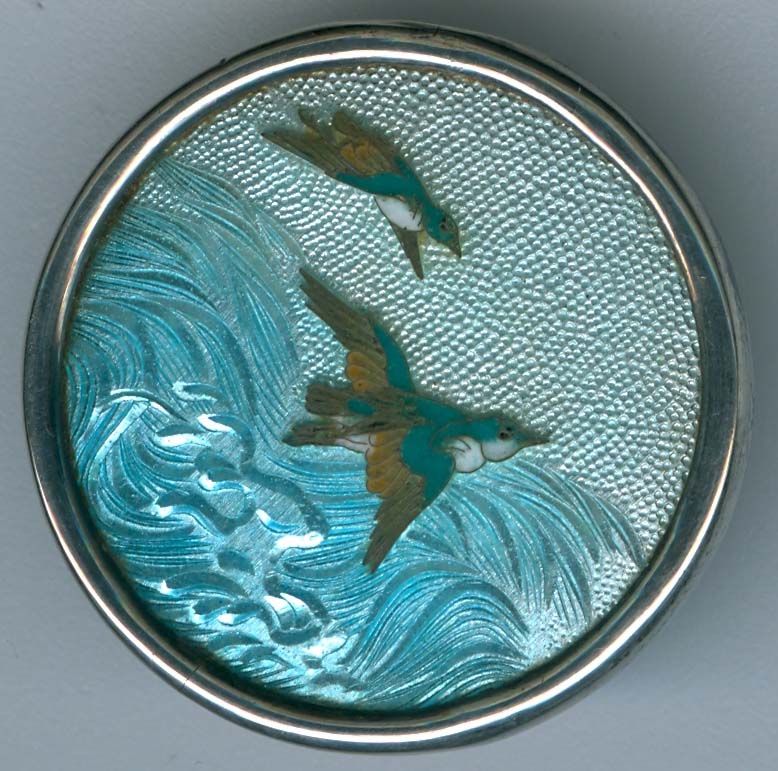
This is not accurate. Gin-bari (or Ginbari) does have silver foil as the base and is an enameling technique which can include, but doesn't have to include, Cloisonne. However, Gin-jippo is a description of an enameled piece using silver as the base metal (defined on page 116 in my book) - it's like saying "silver enamelware." When the Gin-jippo base is texturized, it is silver Basse Taille which can include, but doesn't have to include, Cloisonne. It is sometimes difficult to distinguish the difference between Gin-bari and Silver Basse Taille, with or without Cloisonne. My study of these two techniques have led me to create a list that may help determine the differences. Furthermore, while I believe my list is comprehensive and useful, I wanted to collaborate with experts who could validate my list. Unfortunately, my two experts I used while writing my book have passed away. The two renown gentlemen were Gregory Irvine, curator of the Japanese exhibts at Victoria and Albert Museum in England, and Fredrice Schneider, author of The Art of Japanese Cloisonné Enamel: History, Techniques and Artists, 1600 to the Present (both have confirmed my definitions). In the meantime, I will continue to seek and connect with other experts in order to validate my list. If anyone can assist, please email me. Additions and corrections are always welcome. Here is my list, with examples, on how to tell the difference between Gin-bari and Silver Basse Taille.
|
||||||||||||
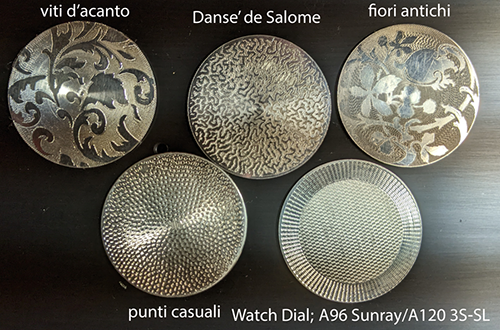
GuillochÉAs described in the book (page 43), Guilloché is a specialized form of Basse Taille in that the pattern has to be engraved by an engine-turning machine, operated by a skilled craftperson. This section provides some additional information about this enameling technique. Note the word: "engraved" in the paragraph above. This means that the lines are cut INTO the metal surface and are thus indented. No Guilloché pattern is raised above the surface as that would have resulted by an embossing/casting method. Another tell is if the indented lines are curved at the bottom, not sharp - remember that Guilloché is as bright as it is becuase the engraving is at an angle and sharp so that the light reflects brilliantly through the enamel. Be sure to keep these concepts in mind when purchasing a button labeled as Guilloché. The Enamel Tech Talk sidebar called Engine-Turning Machines For Guilloché (page 44) goes over the 3 types of machines that produce patterns for Guiloché. Most buttons have radial designs which are from the Rose engine. The Straight-line engine produces fancy lines that are parallel and I have at least one button from that machine (button 348, page 83). The Brocade engine has much more complex designs and cannot always be identified as Guilloché without being told. Here are metal pieces I just bought to make buttons. These were done by engine-turner Tig Lichty. Note: all in the photo are done by a Brocade engine except the lower right which was from both a Rose Engine (radial border) and a Line Engine (center pattern).
I would like to point out three errors in the book regarding this technique (these can be found on the Corrections page):
|
||||||||||||
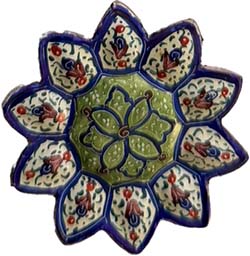
Persian EnamelsOn page 58, the Émaux Peints design style of Persain/Iranian enamels is listed. It states that Minakari is their name for enameling and means "miniature of fire." In speaking with a modern Iranian enamelist, Amir Sheikhvand, I've learned a bit more about this term "Minakari"... Amir says: "Mina actually derives from Minoo, Persian for "heaven/paradise" (referring to the azure-blue enamel color), not literally "miniature." Kari means "work." So the technical etymology is closer to "heaven-work" or "azure work." That said, "miniature of fire" is a widely repeated poetic gloss used across tourism and craft sources to describe the art... ["miniature of fire" is] just presenting a popularized translation as if literal." Here is one of Amir's designs who may be making buttons for us in the future.
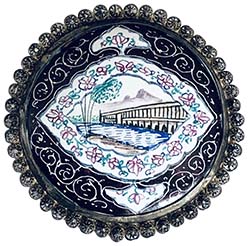
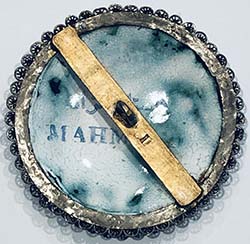
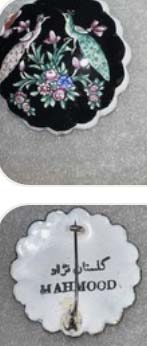
Amir says: "Almost all enamels in the Qajar dynasty were done by artists hired exclusively for the court..." The style was very ornate with ornate settings like the Badge of the Order of the Lion and Sun. "By the end of Qajar rule, enameling was almost unknown." Most of these were not the style we see today - "...the Minakari style ... came into play in society during the early Pahlavi era." This style is Émaux Peints with Sgraffito, made after 1940. The bridge shown in a couple of the buttons (button 217 on page 58 and button 260 oage 65) is the famous bridge called 33 Bridge or Si-o-se-pol. The bird painting, button 215 on page 58, is older than the other style and does not include Sgraffito. it is not frequently done anymore because of the time it take to execute them. Many Persian buttons were not back marked because they were either done by a collective group or for the court. However, this one was. From Inge Borland we have found that this was the artist Mahmood. Because he did both styles - the older more elaborate style and the Minakari style he proably worked in the 1940s time. More info to come, hopefully.
|

last updated
09/10/2026